

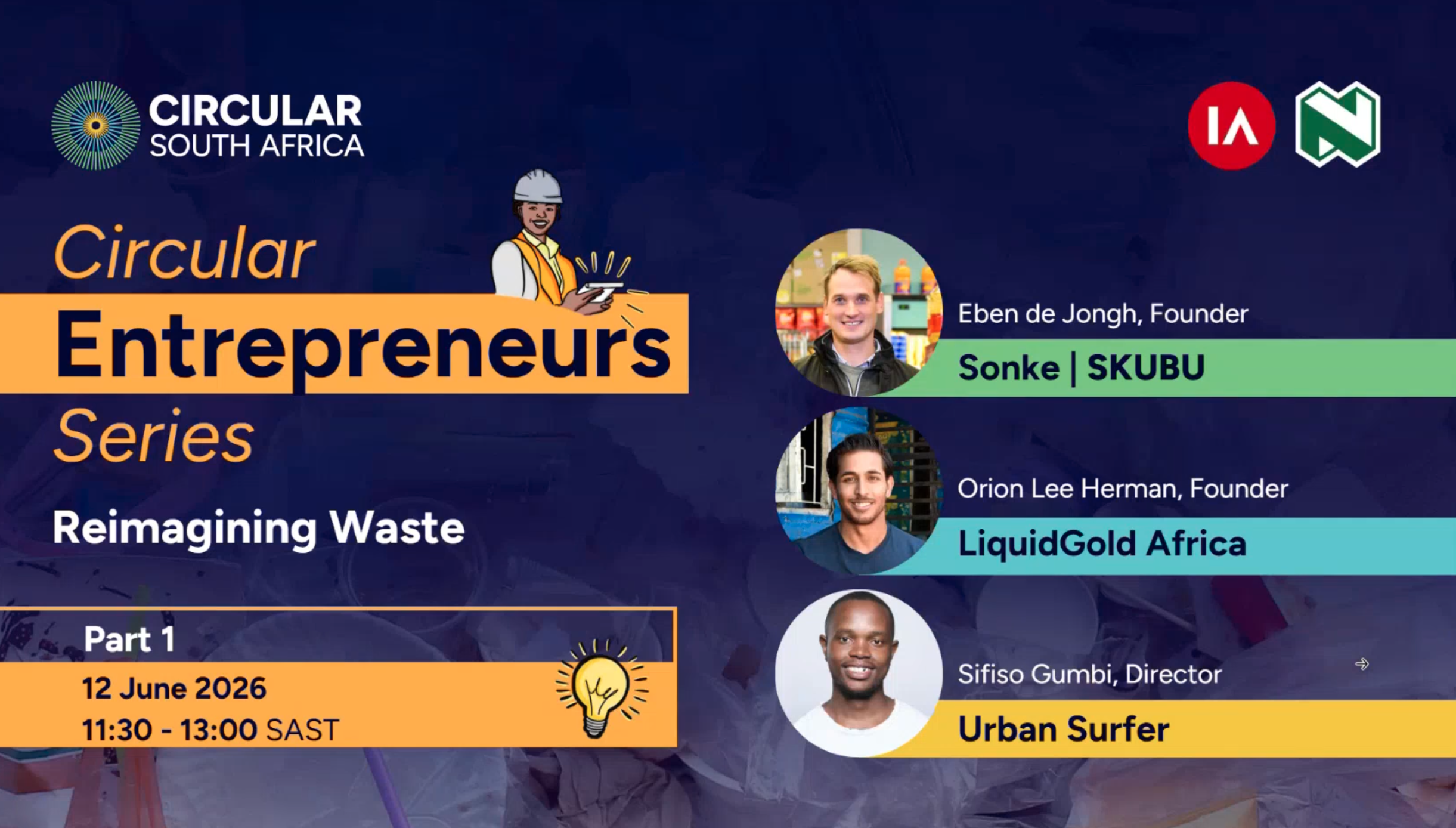
The first session of the Circular Entrepreneurs Series brought together ReNEW ventures, ecosystem partners and circular economy champions to explore what it really means to reimagine waste — from a business, social and environmental perspective.
Hosted jointly by Circular South Africa and the Nedbank ReNEW programme on 12 June 2026, the session drew an engaged audience of practitioners, investors and aspiring circular entrepreneurs. The event opened with a compelling framing of why the transition from a linear "take-make-waste" economy toward a regenerative circular model is not just an environmental imperative — it is a profound economic and social opportunity for South Africa.
Watch the full session
The strategic platform behind ReNEW
Stakeholders from Nedbank and Impact Amplifier opened the session by articulating the programme's purpose: a bespoke acceleration platform providing both capital and structured support to post-revenue startups tackling waste and circular innovation. The ambition is not just business growth — it is economic and generational transformation, creating lasting pathways for young South Africans into the circular economy.
Three entrepreneurs, three circular models
The heart of the session was a presentation by three Nedbank ReNEW ventures, each illustrating a different dimension of what the circular economy looks like in practice across South Africa.
LiquidGold Africa — Organic waste recovery
Orion Lee Herman detailed LiquidGold's work in organic waste recovery, including an off-grid machine that converts human waste into biological fertilizer — a breakthrough that addresses both sanitation deficits and the demand for natural soil inputs in agriculture. The venture exemplifies the circular principle: turning what is discarded into something of genuine value.
Urban Surfer — Dignity and data for informal reclaimers
Sifiso Gumbi shared how Urban Surfer is transforming the lives of South Africa's informal waste reclaimers. Through data-driven training, essential PPE and community-based recycling hubs, Urban Surfer ensures that the people doing the hard work of recycling are treated with dignity and paid fairly — formalising an informal sector that underpins much of the country's recycling infrastructure.
Sonke | SKUBU — Refill stores that reduce plastic and cost
Eben de Jongh explained Sonke's vertically integrated, automated refill store model that dramatically reduces plastic packaging while significantly lowering costs for low-income consumers. By removing single-use packaging from the equation, Sonke simultaneously solves an affordability problem and a waste problem — two challenges that South Africa's most vulnerable communities face daily.
The Q&A: Scaling, focus and the "Google of recycling"
The session concluded with a lively Q&A that surfaced themes relevant to any circular entrepreneur. The panelists were candid about the challenges of scaling — and unanimous on one point: growth often comes not from saying yes to every opportunity, but from the discipline to say no to those that pull a venture off course.
The conversation also explored an ambitious concept: a "Google of recycling" — an interconnected ecosystem platform that would allow corporates to easily identify and plug in circular economy solutions across the country. It is a vision that speaks directly to what Nedbank ReNEW and the Ecosystem Map are building: the connective tissue that makes South Africa's circular economy legible, accessible and scalable.