

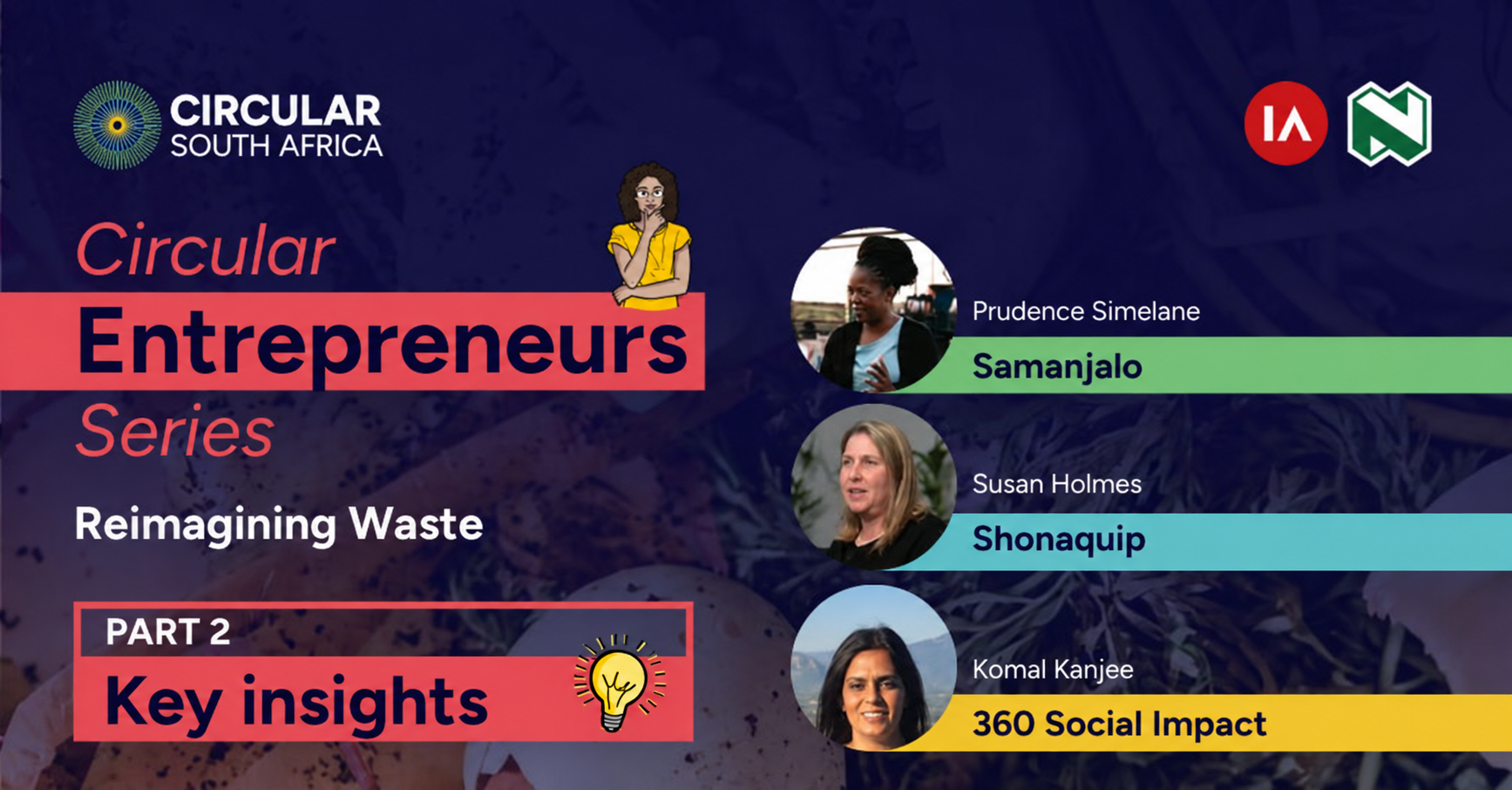
The second webinar in the Circular Entrepreneurs Series brought the circular economy down to a practical level, with three women-led businesses showing how waste can become the basis for viable products, stronger livelihoods and new economic opportunities.
Hosted by Circular South Africa in partnership with Nedbank ReNEW and Impact Amplifier, Part 2 of Reimagining Waste featured Prudence Simelane of Samanjalo, Susan Holmes of Shonaquip and Komal Kanjee of 360 Social Impact. Their businesses work with vastly different waste streams, but each is tackling the fundamental challenge of finding ways to keep materials in productive use and create value from resources that would otherwise be discarded.
The circular economy needs businesses that work
The webinar opened with a reminder that circularity is ultimately a systems shift. Instead of the traditional take-make-waste model, materials need to remain in use for longer through approaches ranging from redesign and reuse to repair, repurposing, recycling and recovery.
For entrepreneurs, this creates commercial opportunities alongside environmental benefits. The three businesses featured in the webinar demonstrated what this can look like in practice, from coal waste in Mpumalanga and food waste in commercial kitchens to the equipment used by informal waste reclaimers.
The Nedbank ReNEW Programme is helping businesses working in this space strengthen their models and prepare for growth. The programme attracted 225 applications from South African enterprises, more than double its original target, with 111 enterprises participating in group acceleration and seven receiving one-on-one acceleration support.
Turning mineral waste into building materials
Samanjalo is a mineral waste beneficiation business based in eMalahleni, Mpumalanga, where decades of coal-based activity have left large volumes of industrial waste.
The company uses geopolymer technology developed in partnership with the CSIR to turn mineral waste into construction materials. According to founder and CEO Prudence Simelane, the technology can incorporate more than 70% mineral waste into its products while reducing carbon emissions in the production process by up to 80% compared with conventional binders.
Samanjalo has entered the market through brick manufacturing and is producing stock, hollow and maxi bricks, with paving products also in development. Its longer-term model is designed to be replicated close to other sources of mineral waste rather than transporting waste over long distances.
This approach has particular relevance in former and transitioning mining communities. Beneficiating waste locally can support new economic activity and employment as traditional industries change, while dealing with the environmental legacy they leave behind.
The discussion also highlighted an important challenge for businesses reaching this stage of development: access to the right kind of capital. As Samanjalo moves beyond early-stage infrastructure and market development, its funding needs are beginning to shift from grants towards commercial and concessionary finance that can support increased production capacity.
Better tools can strengthen waste reclaimers’ livelihoods
Shonaquip approached circularity from the angle of improving the equipment available to the people already recovering valuable materials from South Africa's waste stream.
Its purpose-built waste reclamation trolley allows reclaimers to transport greater volumes of recyclable material more efficiently. In a Department of Environmental Affairs project implemented between 2021 and 2023, participants increased their income by an average of 240%, according to Shonaquip. The project also contributed to the formalisation of ten organisations.
Susan Holmes shared an example of a reclaimer who had previously been chased away by residents while collecting recyclables. When he returned using a purpose-built trolley, the interaction changed, and a resident invited him to collect glass directly from her home.
Shonaquip is now developing a rent-to-own model that could make the trolleys accessible to reclaimers who cannot afford to purchase them upfront. Payments made each time a trolley is hired contribute towards eventual ownership, creating the potential for reclaimers to build their own small fleet and generate additional income by renting equipment to others.
Tackling food waste where it happens
360 Social Impact is focused on the food and organic waste generated by restaurants, hotels, shopping centres and other commercial operations.
Its technology processes organic waste on site and converts it into compost within 24 hours. Depending on the application, the systems can process anything from smaller commercial volumes to customised solutions handling several tonnes per day.
The on-site model addresses several problems at once. It reduces the volume of organic waste going to landfill, cuts the transport associated with moving that waste and creates a usable organic output. According to 360 Social Impact, the process reduces the original volume by around 90%, leaving approximately 10% as compost.
The business is currently working towards accreditation and further testing of the compost, while exploring pilot opportunities with municipalities, fresh produce markets, hospitals and other large waste generators.
Moving from promising solutions to scale
The Q&A brought several of the practical barriers to circular business growth into focus. These included product standards and procurement, access to finance, regulation, testing, infrastructure and the partnerships required to move from pilot projects into larger markets.
Government and corporate procurement can play an important role. For businesses such as Samanjalo, specifying environmentally responsible materials in construction projects could create significant demand for locally produced circular products. For Shonaquip, the next step is proving and refining its waste-reclaimer model before deploying larger amounts of commercial capital. For 360 Social Impact, further testing and demonstration projects will help establish the technology at scale.
Part 2 of Reimagining Waste showed that South Africa already has entrepreneurs building practical responses to some of its most persistent waste challenges. The opportunity now lies in creating the conditions for those solutions to grow.
Part 3 coming soon
The Circular Entrepreneurs Series continues with one final webinar where Impact Amplifier will be launching a dynamic new platform for enterprises, investors and ecosystem enablers transforming waste into opportunity. Look out for details on Part 3 coming soon.